Commercial Roof Repair vs. Replacement: What Colorado Springs Property Owners Should Know
A leaking commercial roof doesn’t wait for a convenient time to become a problem. Whether it’s a ponding water issue on a flat TPO roof or a failing seam on an aging EPDM system, the decision between repairing what’s there and replacing the whole system carries real cost implications either way. Getting that call wrong in either direction, patching a roof that needs full replacement, or replacing one that only needed a targeted fix, is an expensive mistake.
Here’s how commercial roofing actually fails, what separates a repair situation from a replacement one, and what the decision typically costs in Colorado Springs.
Common Commercial Roofing Systems and How They Fail
Commercial roofs in Colorado Springs are almost always flat or low-slope, which means they fail differently than a residential shingle roof. According to the National Roofing Contractors Association, proper installation and membrane-specific maintenance requirements vary significantly by system type, which is why an inspector familiar with commercial systems matters as much as one familiar with residential shingles. The most common systems are TPO, EPDM, PVC, and modified bitumen, each with its own typical failure points:
• TPO Membrane — Seam separation over time is the most common issue, especially at aging seams that weren’t heat-welded correctly during the original install.
• EPDM Membrane — Punctures and shrinkage at the edges are the usual culprits, along with seam failure at flashing points.
• PVC Membrane — Generally durable, but seam and flashing failures still occur, particularly around rooftop HVAC penetrations.
• Modified Bitumen — Cracking and blistering from UV exposure and thermal cycling, more common on older installations.
Ponding water is a factor across all four systems. Flat roofs rely on proper slope and drainage, and even a small low spot that holds water for 48+ hours accelerates membrane breakdown regardless of material.
Is Commercial Roof Repair or Replacement Right for Your Building?
The same 30 percent rule that applies to residential roofing is a reasonable starting point commercially too: if the damage or wear affects less than about 30 percent of the roof surface and the membrane is otherwise sound, repair is usually the more cost-effective path. Beyond that threshold, or when the roof is already past its expected service life, replacement becomes the better long-term investment.
Repair typically makes sense when:
• Damage or wear is isolated to a specific area (a seam, a penetration point, a section with ponding)
• The roof is within its expected lifespan for its material (roughly 15-20 years for most membrane systems)
• The building’s ongoing operations can’t accommodate an extended replacement timeline right now
Replacement typically makes sense when:
• Multiple areas show membrane failure, not just one isolated spot
• The roof has already had several repairs and continues to leak
• The roof is near or past its expected service life
• Ponding water is a structural, not just cosmetic, drainage problem
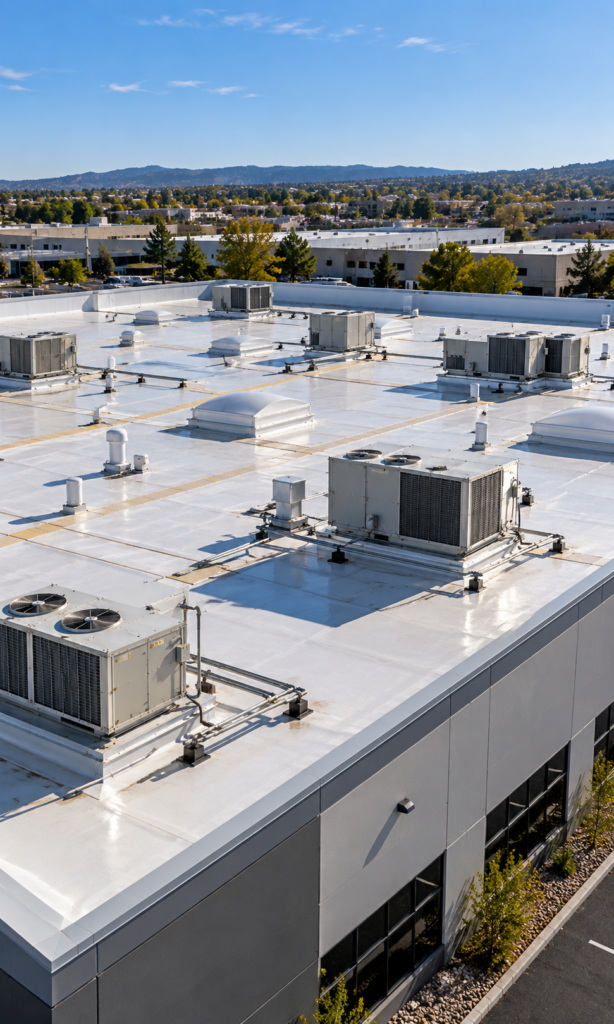
Signs Your Commercial Roof Needs Repair
• A specific leak traced to one identifiable area
• Localized ponding that clears within 24-48 hours after rain
• Isolated membrane punctures or seam separation
• Minor flashing issues around a single HVAC unit or vent
Signs You Need a Full Commercial Roof Replacement
• Leaks in multiple, unrelated areas of the roof
• Membrane that’s brittle, cracking, or blistering across large sections
• Ponding water that doesn’t drain within 48 hours in multiple spots
• A roof already at or beyond its expected service life with a history of repeated repairs
What Does Commercial Roof Repair Cost in Colorado Springs?
Commercial roof repair costs vary widely based on the extent of the damage and the roofing system involved, generally running from a few hundred dollars for a small isolated fix to several thousand for more extensive membrane or flashing work. Full replacement costs scale with square footage and system type, and are best quoted after an on-site roof inspection rather than estimated over the phone. Property owners managing multiple buildings or larger square footage should expect replacement quotes to be itemized by section, since a large commercial roof often has varying condition across different areas rather than uniform wear.
Commercial Roofing in Colorado’s Climate
Colorado Springs’ hail frequency and intense UV exposure at altitude affect commercial membrane roofing differently than residential shingles. Hail can bruise or puncture membrane roofing depending on the system and its age, and prolonged UV exposure accelerates the breakdown of some membrane types faster than manufacturers’ base ratings account for at sea level. According to EPA guidance on stormwater management, proper roof drainage design is directly tied to long-term structural protection, which is part of why ponding water issues shouldn’t be treated as purely cosmetic on a commercial building.
Regular commercial roof inspections catch developing issues, seam separation, early ponding, minor punctures, before they become the kind of widespread damage that forces a full replacement decision.
Frequently Asked Questions About Commercial Roof Repair and Replacement
How do I know if my commercial roof needs repair or replacement?
If damage or wear is isolated to a specific area and the roof is otherwise within its expected lifespan, repair usually makes sense. If multiple areas show failure, or the roof already has a history of repeated repairs, replacement is typically the more cost-effective long-term choice.
What's the average lifespan of a commercial roofing system?
Most membrane systems (TPO, EPDM, PVC) last 15 to 20 years with proper maintenance. Modified bitumen systems can vary more depending on installation quality and UV exposure.
Does ponding water always mean I need a new roof?
Not necessarily. Isolated ponding that drains within 24-48 hours may be a maintenance and drainage fix rather than a full replacement. Ponding that persists longer, or occurs in multiple areas, is a stronger signal that structural drainage issues need to be addressed at the replacement level.
Can commercial roof repairs be done without disrupting business operations?
In most cases, yes. Repairs are typically localized and can often be scheduled around business hours. Full replacements require more planning, particularly for buildings that can’t accommodate extended construction access.
Does insurance cover commercial roof damage from hail?
Often, if the damage is from a covered event. Documentation from a professional inspection makes a meaningful difference in how a commercial insurance claim gets resolved, similar to residential claims.
Get an Honest Assessment for Your Commercial Roof
Whether your building needs a targeted repair or a full system replacement, an accurate assessment starts with an on-site inspection, not a guess based on age or a quick look from the ground. Call 719-339-4004 or visit our commercial roofing services page to schedule an inspection for your property.